
Skincare folding cartons.
One coordinated range.
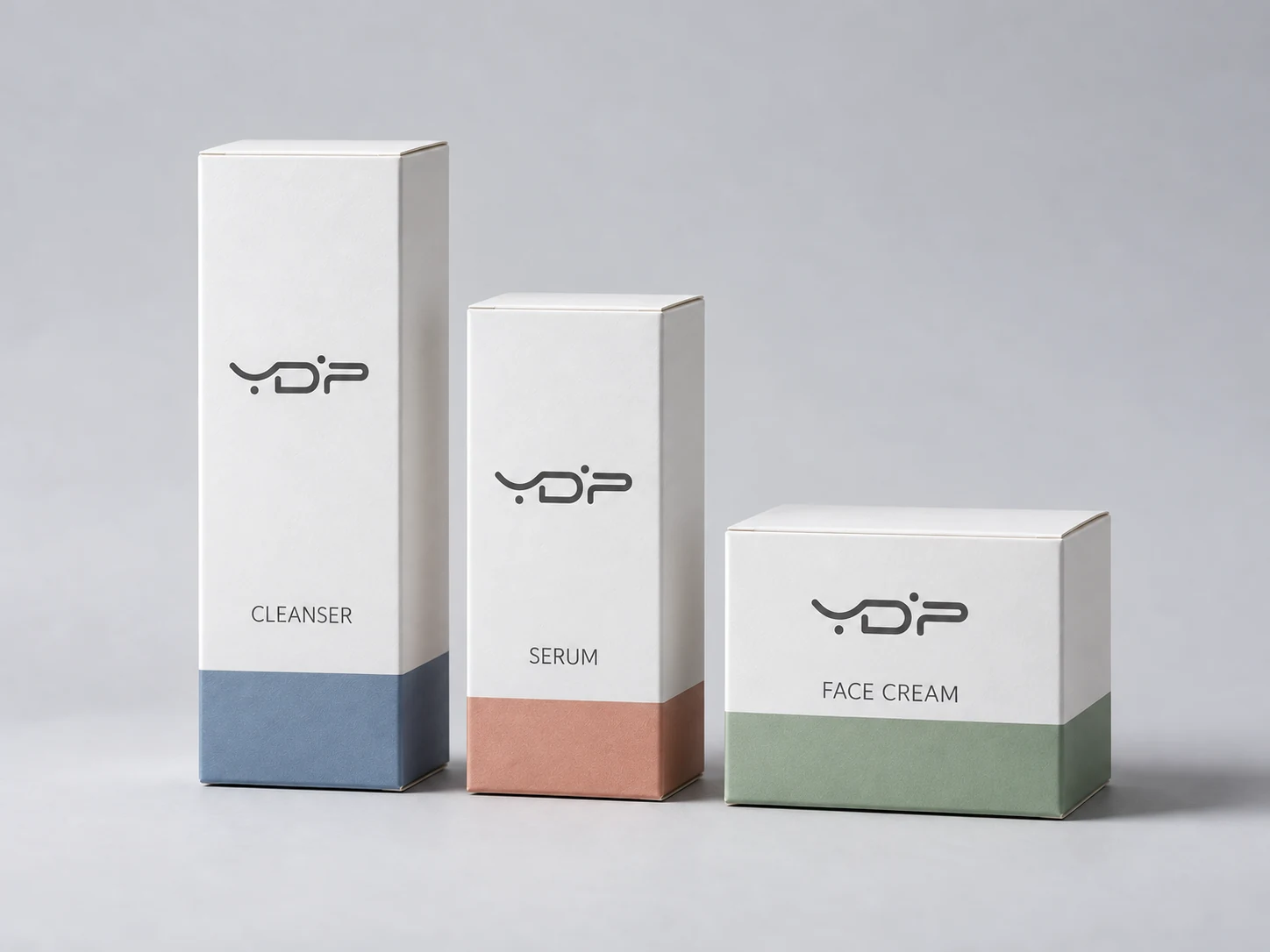
Three retail cartons with shared branding, individual container fit and a paperboard insert for the serum.
Minimum order: 500 pieces. Start with a photo or a short request.
The starting direction
- Application
- Individual retail cartons
- Structure
- Tuck-top; size by product
- Material
- White folding boxboard
- Branding
- Shared print & matte finish
- Support
- Paperboard bridge for serum
- Supply
- Glued cartons, supplied flat
Comparing options for your own products? Explore folding cartons for beauty and personal care ↗︎
PACKAGINGFit, materials and finish require physical sample approval.
Explore this case 6 sections
Recognisable together.
Distinct individually.
Keep the white base, charcoal logo and typography consistent. Blue, terracotta and sage bands identify the products; adapt the layout to each carton size.
Explore custom cosmetic boxes ↗︎Adding another SKU? See the artwork controls.
Keep a master reference.
Record the logo, type hierarchy, colour references and finish. Compare the range together; use optical balance across the tall and wide panels.
Release each variant separately.
Give each size and artwork a unique SKU and revision. Match the product name, contents, barcode and market-specific copy to its own approved dieline.
Identify the packed components.
Match carton bundles and any inserts to the SKU list. Check the product name and revision as well as the colour band before packing.
Shared branding.
Individual fit.
Size each carton around the finished container, closure and label. Product volume alone is not a box dimension.
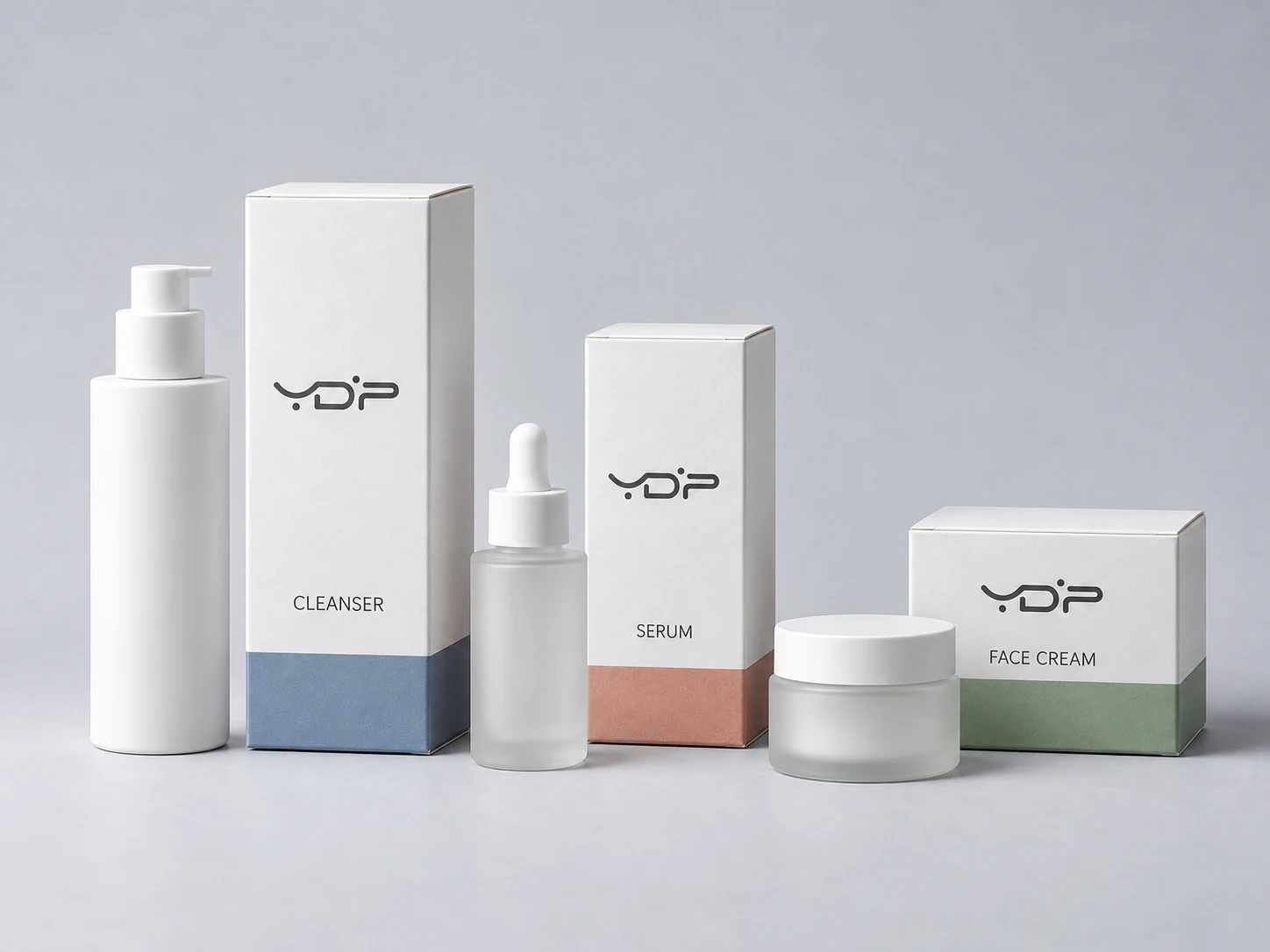
Leave the pump free.
Start with a fitted tuck-top carton without an insert. Check pump clearance and bottle movement.
Locate the bottle.
Trial a folded paperboard bridge that supports positioning without loading the dropper or rubbing the label.
Fit around the lid.
Start with a low, wide carton. Add a locating pad or stronger bottom only if the filled-jar trial calls for it.
Before approving a carton, check loading, closure and removal with your product or an agreed equivalent. Review the product fit checkpoints ↗︎
When should the fit plan change?Adjustment triggers and measurements by product
| Product | Reconsider when… | Useful details |
|---|---|---|
| Cleanser | The bottle shifts or the pump contacts the closure. Review positioning support and usable height. | Finished dimensions, pump shipping position, filled weight and quantity. |
| Serum | The bridge moves, rubs the label or loads the dropper. Compare a fuller paperboard cradle. | Bottle and dropper dimensions, label position, filled weight and quantity. |
| Face cream | The jar moves excessively or the base deflects. Review a locating pad and bottom construction. | Maximum lid diameter, overall height, filled weight and quantity. |
Use the cosmetic carton SKU planning guide ↗︎
Compare carton bottom closures for your products ↗︎
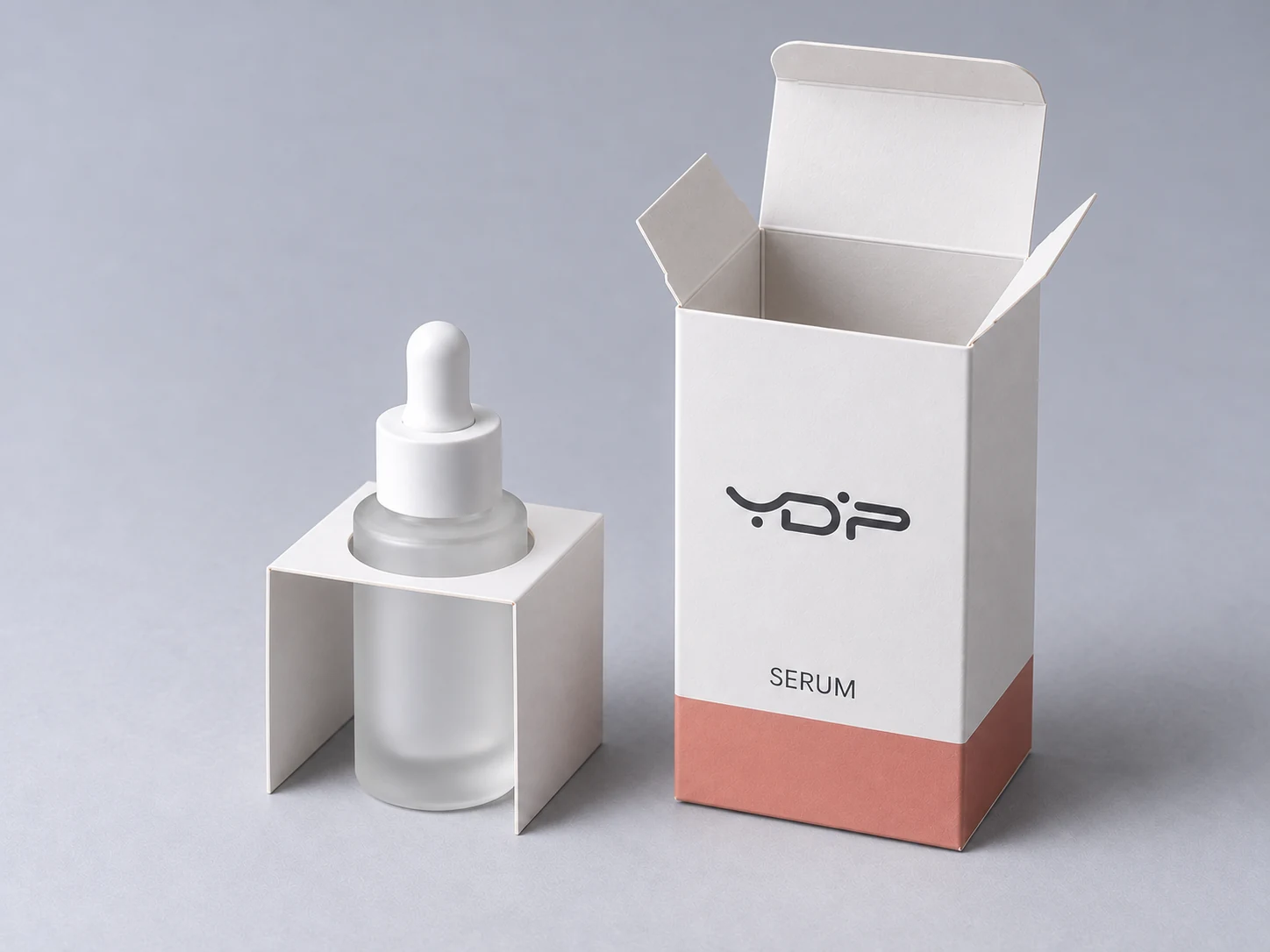
Locate. Support.
Remove easily.
- 01
Fit the opening.
Check the aperture against the finished bottle and label, keeping pressure off the dropper.
- 02
Test the whole assembly.
Confirm how the filled bottle rests on the base and how the folded bridge stays in place.
- 03
Trial packing and removal.
Revise the folds or try a fuller cradle if the insert shifts or catches the label.
Standardise the finish.
Tailor the fit.
Begin with smooth white folding boxboard, printed colour bands and a matte protective varnish to trial across the range.
View the starting specificationCarton, board, print, insert and flat supply
| Part | Starting direction | Confirm for your project |
|---|---|---|
| Carton structure | Tuck-top cartons with individual dielines. Begin by reviewing a tuck-bottom route for manual packing. | If the filled load or packing speed makes a tuck bottom unsuitable, compare a locking or pre-glued bottom. Select after a loaded trial; the bottom is not shown in the visuals. |
| Paperboard | Printable smooth white folding boxboard as the starting option; textured board as a tactile alternative. | Grade, caliper, stiffness and fold quality. Do not select board weight from the image alone. |
| Print & surface | Printed charcoal identity and SKU colour bands, with a matte protective varnish to trial on all three cartons. | Approve physical colour references, fine text and rub resistance on the chosen stock. Reconsider the coating if the sample changes the desired feel or print appearance. |
| Serum insert | A folded paperboard bridge with a bottle aperture as the first structure to trial. | Aperture, crease positions, support, retention and removal. Other products may need different support or none. |
| Supply & packing | Review glued cartons supplied flat, with inserts packed separately or as agreed. | Assembly responsibility, quantities and labels by SKU, outer-carton packing and the distribution route. |
For a tactile finish, compare textured stock and approve fine text, solid colour and creases on that exact paper. The pictured texture does not specify a paper grade.
Compare folding carton options ↗︎Need one common size or a gift set?When this individual-carton approach needs adapting
A common size is an option only if trials show acceptable clearance, support and packing work for every container. A multi-product gift set needs a separate layout. Parcel delivery also requires an outer-pack review.
Approve the family.
Check every member.
Agree sample options, costs and lead times with sales. Each product needs its own fit and artwork approval.
What will the sample review check?Finished-container fit, decorated range and packing
- 01 / STRUCTURAL SAMPLE
Fit the finished products.
Provide containers or dimensioned drawings, filled weights and closure positions. Review insertion, closing, support and removal for each carton.
Decision: three identified dielines and an insert decision for each SKU.
- 02 / DECORATED SAMPLE
Review the range together.
Compare all three on the same paper and under agreed lighting. Check colour bands, logo scale, folds and each SKU’s copy, barcode and required information.
Decision: approved artwork versions and a physical print reference.
- 03 / PACKING REVIEW
Confirm the delivery format.
Trial packing with filled products. Agree the outer packaging and handling checks for your route, then identify cartons and inserts so variants stay separated.
Decision: packing instructions, quantities by SKU and release records.
Minimum order and quotation scope500 pieces; share quantities by product
Minimum order: 500 pieces for all box types. Please list quantities by size and artwork. Send the quantity breakdown by size and artwork so sales can confirm the quotation.
Compare board, printing, finish, inserts, tooling, sample charges and delivery destination on the same basis. To simplify cost, review available board and a shared finish before reducing necessary product support.
Review my SKU list for a quote ↗︎Can the complete pack be called recyclable?Confirm the actual materials and collection route
A paperboard insert alone does not establish this for the whole pack. Review the container, closure, adhesives and coatings against the relevant local recycling route before making a packaging-wide claim.
Choose your next packaging decision.
Choose the carton structure ↗︎
Compare carton fit for tubes, dropper bottles and cream jars.
Plan your cosmetic packaging range ↗︎
Choose individual cartons or a gift set around the selling unit.
Prepare the insert brief ↗︎
Record contact points, product support and removal access.
Beyond skincare.
Reuse the visual system; adapt the fit and product information.
Hair & scalp care
Coordinate pumps, droppers and mask jars. Recheck closures and filled weights.
Bath & body
Match lotions, oils and creams with suitable clearance and surface protection.
Fragrance & grooming
Adapt support and printed copy for sprays, glass bottles and balm jars.